Your product photos decide whether AI recommends you
AI shopping engines now read your product photos, not just your text and feed. Here is the five-shot set they reward, and the feed specs behind getting recommended.
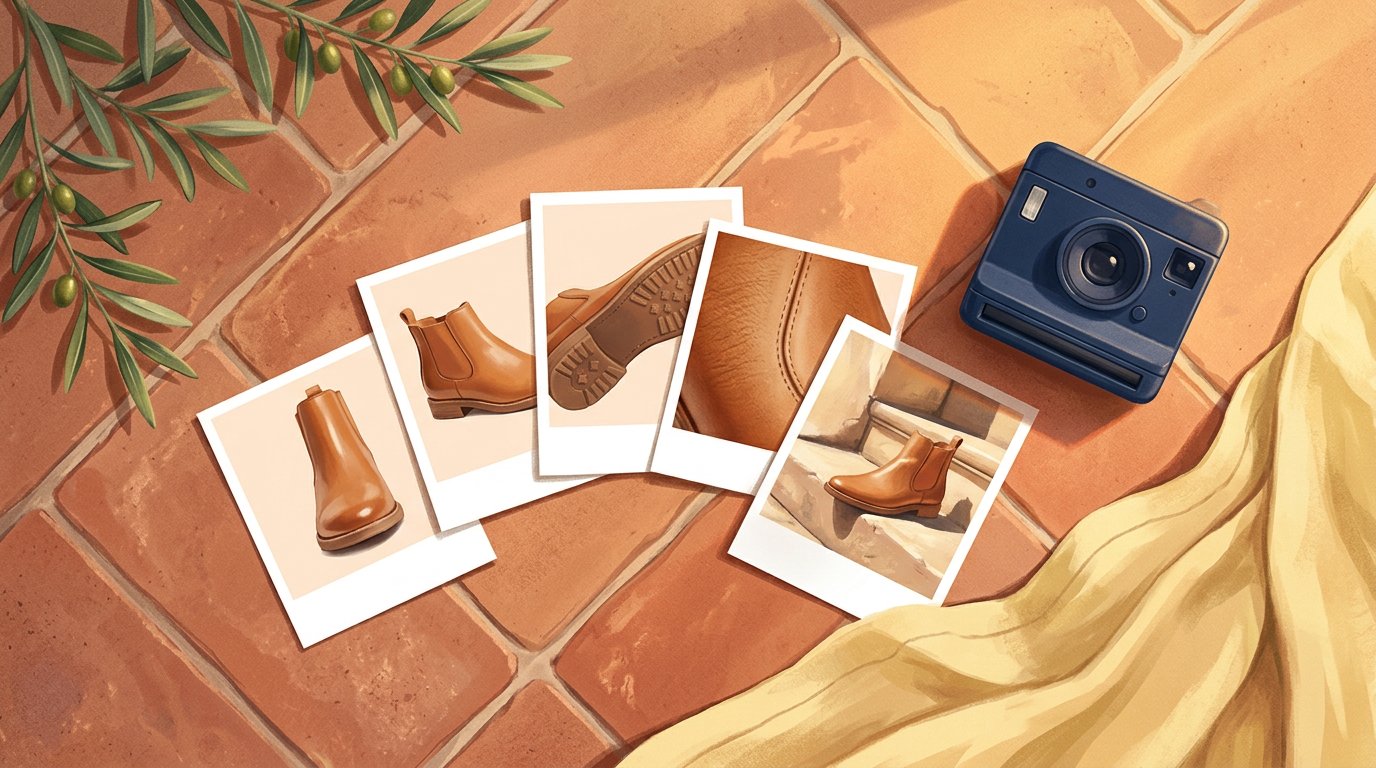
AI shopping engines like ChatGPT, Perplexity, and Google's AI Overviews increasingly read your product images, not just your text and feed data. They reward a specific set: a clean-background hero the model can recognize, several angles, a material close-up, a scale reference, and a lifestyle shot. One mediocre hero photo is how you get skipped.
A shopper opens ChatGPT and types "best waterproof hiking boots under $150." It comes back with three products, images and all, and a line on why each one fits. The shopper taps one and buys. They never saw a results page. They never landed on your store to browse.
That path barely existed eighteen months ago. Over the 2025 holiday season, traffic to US retail sites from AI sources jumped 693% year over year, and those shoppers converted 31% more than visitors from other sources.
So I went looking for how to show up in those answers. Most of what I found was about words: write better descriptions, add structured data, clean up your feed. All true. But almost every guide handled images the same way. One line, "use high-quality photos," then straight back to keywords.
That line kept bugging me. These engines are multimodal now. They look at the picture. If the image is a ranking signal, "use high-quality photos" isn't an instruction. It's a shrug.
So I went into the actual feed specs OpenAI and Google publish. They're specific about images. A lot more specific than the guides let on. And the gap between what they ask for and what most brands upload is enormous.
What AI shopping engines actually do with your images
Short version: more than they used to, and more than your old SEO instincts assume.
The old model was text in, text out. A crawler read your page, matched keywords, ranked links. Images were decoration.
The new model reads the picture. Gartner expects 40% of generative AI tools to be multimodal, working from images and video as well as text, by 2027. In 2023 that was 1%. Google's product search already combines visual analysis with text and shopper behavior to work out what you mean and which products fit. The image isn't decoration anymore. It's evidence.
Two jobs your photos are doing inside these systems:
Recognition. The engine needs to know what the thing is. A clean shot on a plain background, sharp, true color, makes that easy. A dim, cluttered, or busy photo makes it guess. Guessing is how you get left out.
Intent matching. When someone asks for "a minimalist gold necklace for everyday wear," the engine is matching the feel, not just the noun. Lifestyle and in-context shots are how it reads feel. A necklace on a neck in natural light says more about "everyday" than a product cutout ever will.
Here's what reframed it for me. Google scores the quality of your product data, images included, and the higher-scoring listings are the ones it puts forward. Same product, same price. Better image set, better odds of being the one the AI names.
The one-hero-photo problem
Open your own catalog and look honestly. How many products have exactly one usable photo?
For most brands the answer is most of them. One front shot, decent lighting, taken once, never revisited. It was enough when the job was to fill a thumbnail on a category page.
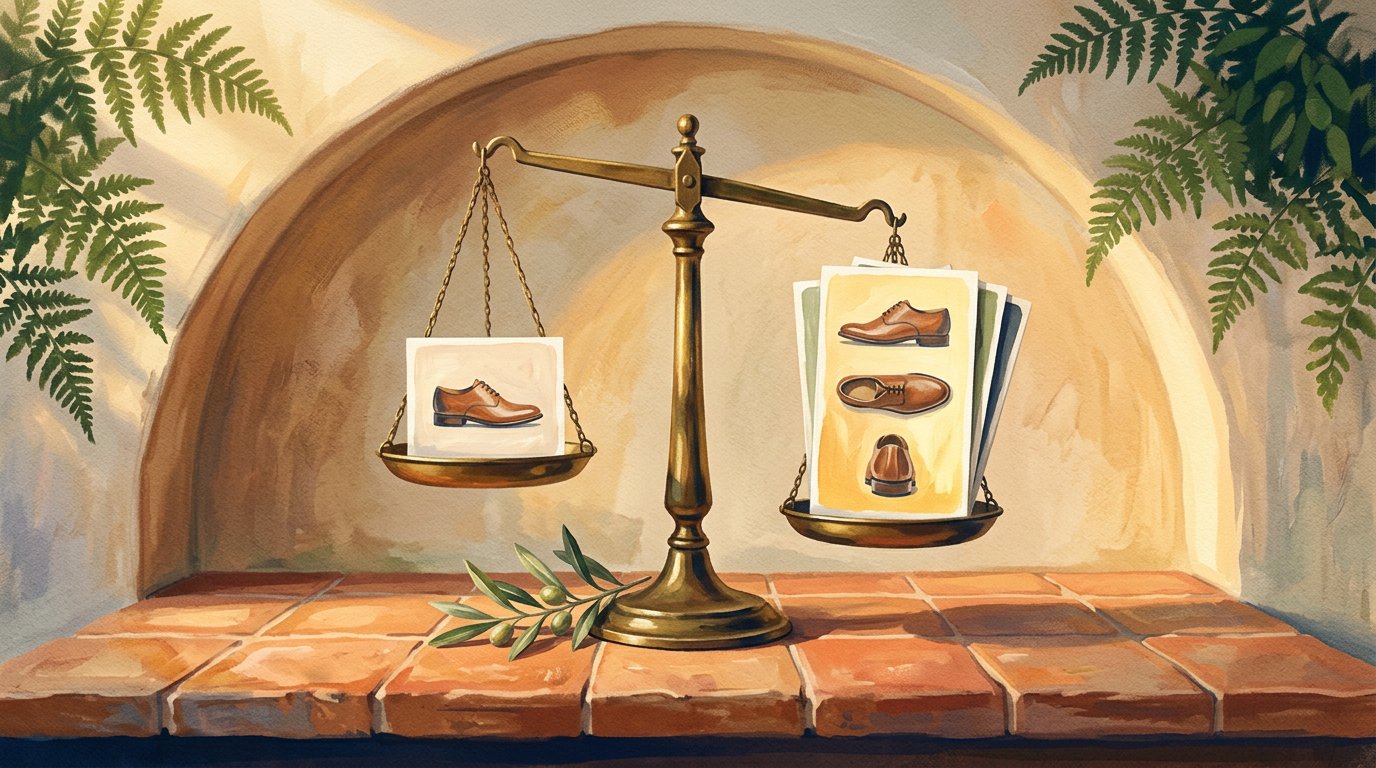
It's not enough now. One photo gives a multimodal engine one angle, one piece of evidence, one shot at recognition and zero help with intent. You're asking it to recommend you on the thinnest possible information, while a competitor hands it five clear signals.
The brands winning in AI shopping aren't the ones with the single most beautiful photo. They're the ones with the most complete set. That's a different goal, and most catalogs are nowhere near it.
What an AI-ready image set looks like
Five shots. Each does a specific job for the engine. This is where I'll get opinionated, because "more images" isn't the point. The right images are.
The clean-background hero. Plain white or neutral, product centered, sharp, true to color. This is the recognition shot, the one the engine leans on to identify the product. Get it wrong and nothing else matters. Google strongly recommends a solid white or transparent background for the main image, and while it won't reject a non-white one outright, a busy hero measurably lowers performance.
Multiple angles. Front, back, side, and the details that matter for the category. The clasp on a bag, the sole on a shoe, the collar on a shirt. Engines learn more from several angles than from one hero, because each angle resolves something the others can't.
The material close-up. A tight shot of texture, weave, grain, finish. This is the one brands skip most, and it's the one that does the heaviest lifting for "what is this actually made of," a question both shoppers and engines care about, especially for anything premium.
The scale reference. Something that says how big the thing is. On a body, in a hand, next to a known object. AI is bad at judging size from a floating cutout. A scale cue answers the question before it's asked.
The lifestyle shot. Product in use, in context, on a person or in a room. This is the intent-matching shot. It's what lets the engine connect your product to "everyday," "cozy," "for a wedding," the soft language people actually search with.
What's not on that list: ten near-identical front shots. Volume for its own sake doesn't help. Five shots that each answer a different question beat fifteen that all answer the same one.
The feed fields that actually carry your images
The image set only counts if the engine can find it. That happens through your product feed, and the fields are public.
OpenAI's product feed spec, the one behind ChatGPT's shopping answers, takes:
image_link: your main image. Required. HTTPS, JPEG or PNG, high resolution, no watermarks.additional_image_link: every other shot. Optional, but this is where your angles, close-ups, and lifestyle images live. OpenAI's own docs say more media improves how well ChatGPT can show your product.video_linkandmodel_3d_link(GLB/GLTF): video and 3D. Most brands have neither, which means there's open ground here.
Google Merchant Center, which feeds Google's AI shopping and overlaps heavily with what ChatGPT pulls, is stricter on the specs:
Minimum 500×500 pixels, and that minimum gets enforced on January 31, 2027, with warnings already showing in accounts since April 2026. Below it, products start getting disapproved.
Google recommends 1500×1500 or larger for best performance across formats.
Same split: main shot in
image_link, everything else inadditional_image_link.
None of this is exotic. It's plumbing. But it's plumbing a lot of brands have never checked, and a product with a 400-pixel hero and no extra images is about to quietly fall out of the surfaces where buying is moving.
Where AI photography fits, and where it doesn't
Here's the bottleneck. The work is obvious: every product needs five good shots, in spec, in the feed. The reason most brands don't have that isn't that they don't know. It's that shooting five angles plus a material close-up plus a lifestyle scene, for every SKU, in a studio, costs more time and money than they have.
That's the real case for AI product photography, and it's narrower than the hype makes it. Not "AI photos are better." They're often not. The case is that AI can produce a complete, consistent set, the white-bg hero, the angles, the lifestyle shot, from one input, across a whole catalog, in an afternoon instead of a month. The win is coverage and consistency, which happens to be exactly what the engines reward.
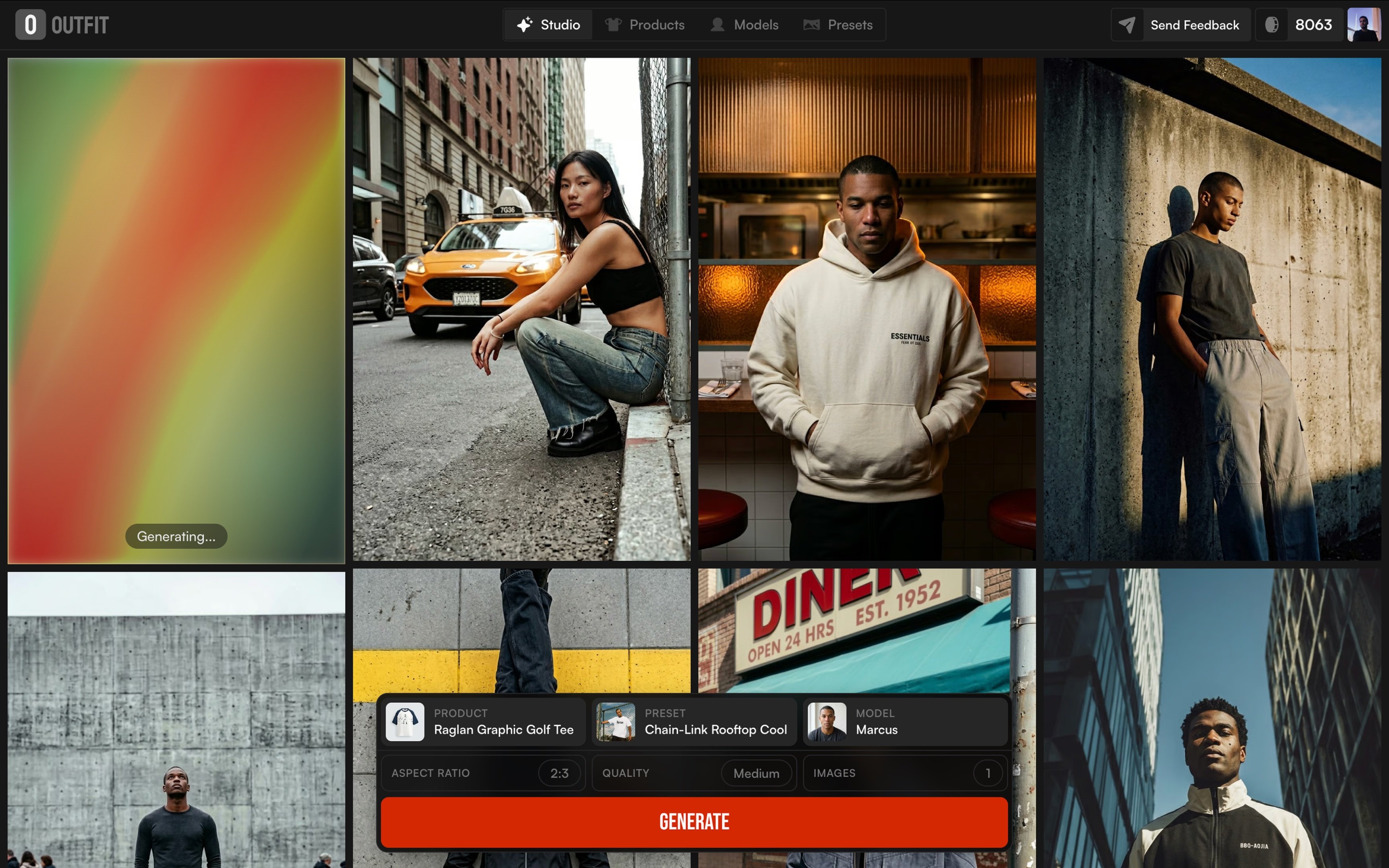
This is what I built Outfit to do, so take it with the appropriate salt. Drop in one product photo, get back the set: clean hero, multiple angles, lifestyle scenes. The point isn't art. It's getting every product up to the bar the engines are now setting, without booking a studio per SKU.
And the honest limit, because it matters. Don't over-style this. The temptation with AI is to make everything a glossy fantasy. Engines, and shoppers, are getting better at smelling that. For the recognition hero especially, you want accurate over impressive. True color, real proportions, no invented details. An AI shot that lies about what the product looks like doesn't just risk a return, it teaches the engine the wrong thing about you. There are also categories, fine jewelry, anything where exact texture is the product, where a real macro shot still beats a generated one. Use AI for coverage, not for pretending.
A 20-minute audit of your catalog
You don't need a project to start. Pick your ten best-selling products and check each one:
Count the images. Fewer than four? That's your first gap.
Check the hero background. Clean and neutral, or busy and dim? Fix the busy ones first.
Look for a material close-up. Almost nobody has one. Add it.
Look for a scale cue and a lifestyle shot. Missing? Those are your intent signals, and they're probably why you're invisible for "for everyday" style searches.
Open your feed and check the pixels. Anything under 500×500 is on borrowed time. Aim for 1500×1500.
Do that for ten products and the pattern shows up across all of them. Fix the ten that sell most, then work down. You'll likely be ahead of most of your competitors inside a week, because most of them haven't looked.
FAQ
Does ChatGPT actually look at my product images, or just the text? Both, and increasingly the images. ChatGPT's shopping answers pull from product feeds that include your image fields, and the underlying models are multimodal, so the picture is part of what gets evaluated. A strong image set makes your product easier to surface and show.
White background or lifestyle, which one wins? You need both, for different jobs. The clean white or neutral hero is for recognition and is the recommended main image on Google and the surfaces that mirror it. Lifestyle shots go in your additional images and do the intent-matching work for feel-based searches. Don't pick one. Supply both.
How many product images do I actually need? Aim for five that each do a different job: clean hero, multiple angles, material close-up, scale reference, lifestyle. More is fine but hits diminishing returns fast. Five distinct shots beat fifteen near-duplicates.
Will AI-generated photos hurt my visibility in AI search? Not if they're accurate. Engines reward clear, complete, in-spec images, and they don't currently penalize images for being AI-made. They do effectively penalize images that misrepresent the product, because that drives returns and bad signals. Use AI for coverage and consistency, keep the hero honest.
Does this apply to Google AI Overviews, not just ChatGPT? Yes. Google's AI shopping runs on your Merchant Center feed and its product quality scoring, where image quality and completeness are direct inputs. The same image set that helps in ChatGPT and Perplexity helps in Google's AI answers.
The takeaway
The text side of AI search is getting crowded fast. Everyone's writing the descriptions and adding the structured data. Fewer people are fixing their images, even though the engines went multimodal and started reading them.
That's the opening. Five good shots per product, in spec, in your feed. It's not glamorous and it's not hard to understand. It's just work most brands haven't done yet, which is exactly why doing it now puts you in the answer instead of your competitor.