Can customers tell your product photos are AI? And do they care?
Most shoppers cannot reliably tell AI product photos from real ones. The ones who can mostly do not care, except in three specific cases this post breaks down.
Most shoppers can't reliably tell AI product photos from real ones in a normal shopping flow. The small group that can tell mostly doesn't care, except in three specific cases I'll get into below.
Every founder who's about to ship their first batch of AI product photos asks me the same thing. Some version of: "Will my customers know?"
And the second one, quieter: "Will they hold it against me?"
Fair questions. I want to answer both honestly here, not with the marketing answer.
Short version: most shoppers can't tell, and most of the ones who can don't care. There are three situations where AI photos do cost you real sales, and they're worth knowing about before you ship.
I'll prove the first part with a small test you can take right now, then walk through three real brands shipping AI photos and what each one is teaching the rest of us.
Try this first: real or AI?
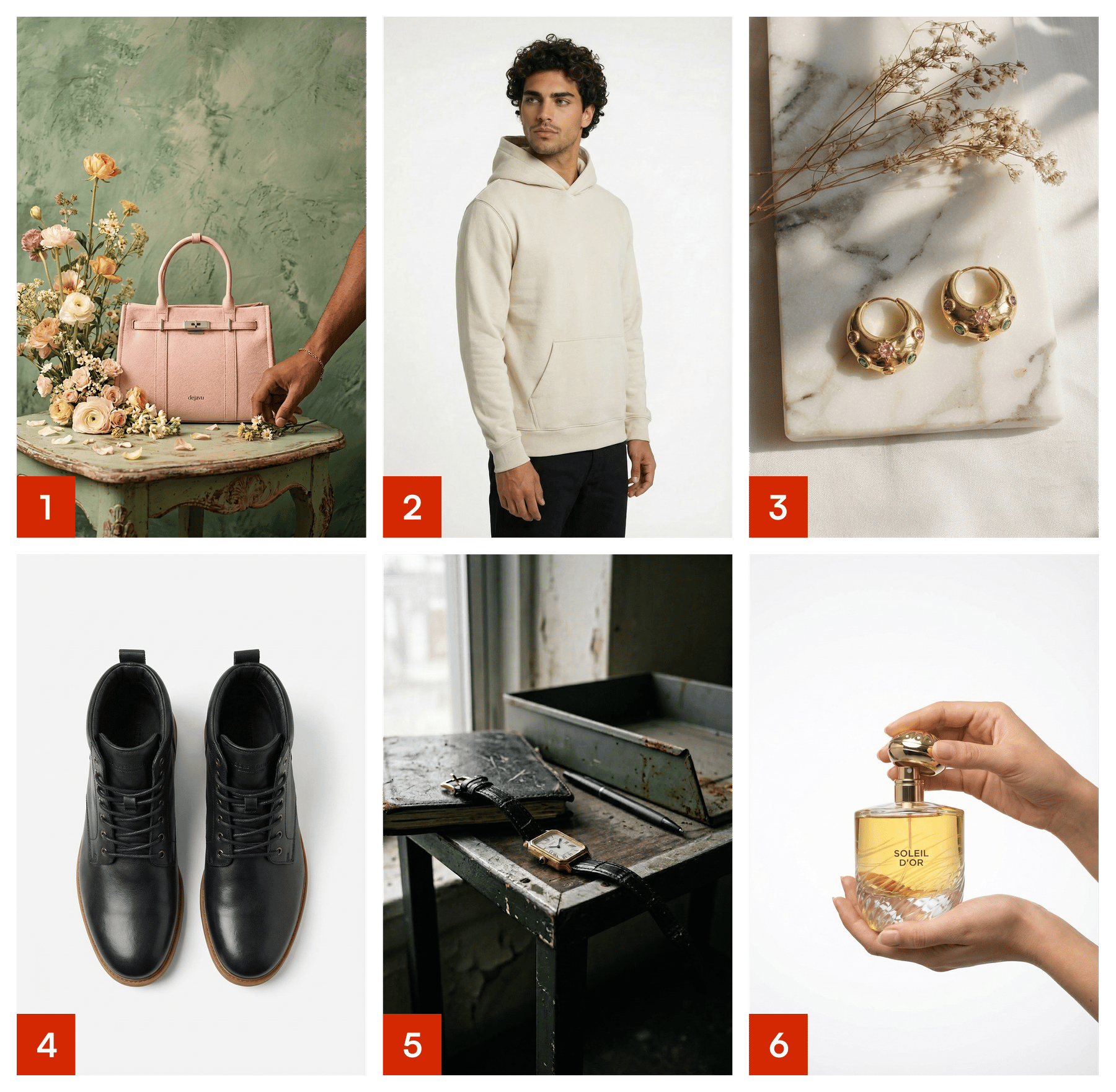
Below are six product photos across six different categories. For each one, pick: real studio shot, or AI? Lock in your guesses for all six, then keep reading.
Got six guesses? Good.
The answer
They're all AI.
Every one of them. No studio, no model, no photographer.
If you guessed "real" on any of them, you're in the majority of people I've run this on. Most founders catch maybe one or two. A few catch none. The photographers I've shown it to catch three on a good day.
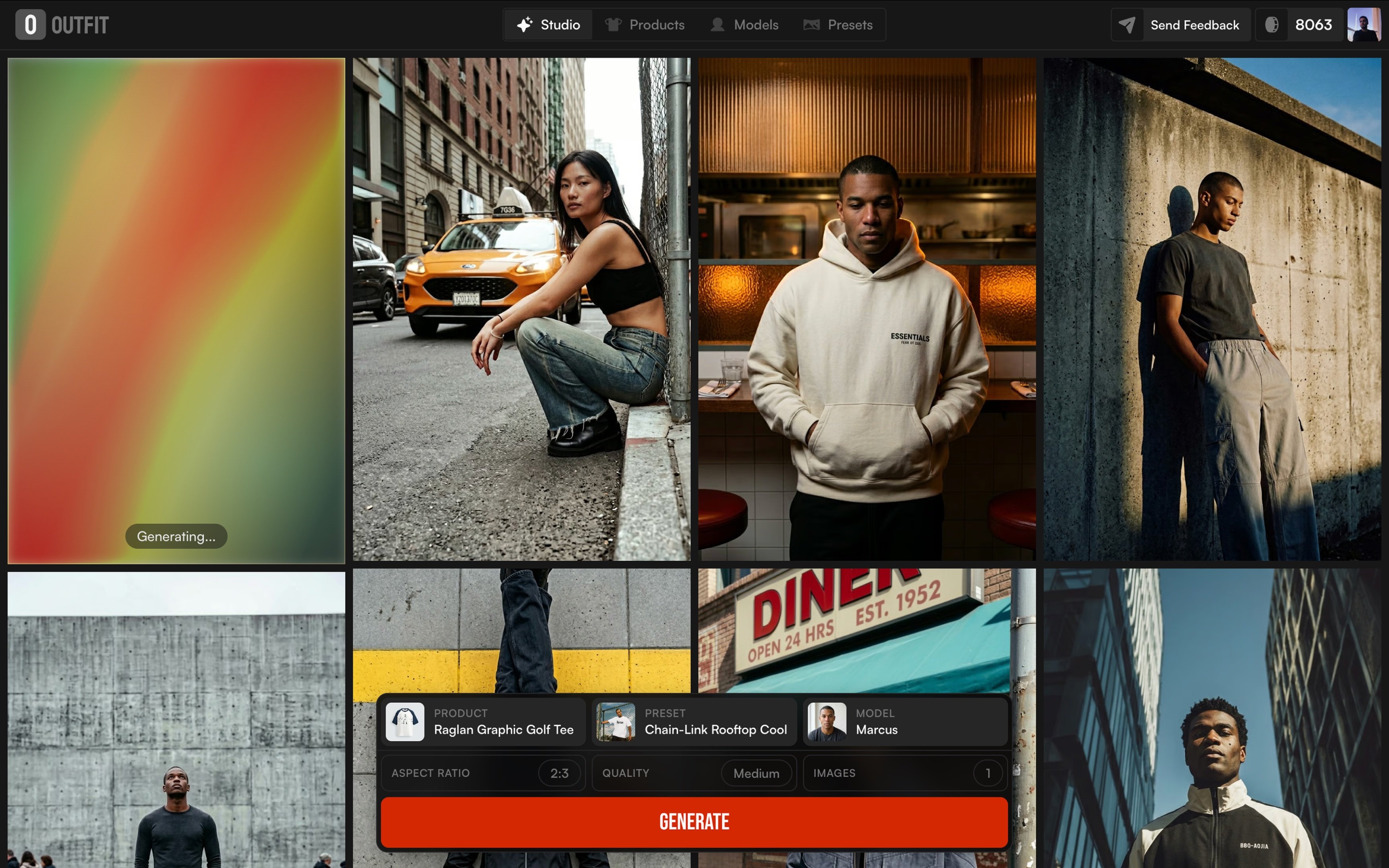
These aren't cherry-picked best-case generations either. They're the kind of output a competent operator gets from a tool like Outfit on a normal Tuesday. I picked six different categories on purpose: leather bag, on-model apparel, fine jewelry, footwear, lifestyle watch, perfume. Each is a category where founders ask me whether AI is "ready yet."
The reason I lead with this trick is that the whole "can customers tell?" question is built on an assumption that stopped being true about eighteen months ago. The assumption is that there's a reliable visual tell. There mostly isn't, not in product photography at the resolution and context where shoppers actually see them.
Here's what I'd point at in each, going one by one, if I were trying to flag the giveaway:
1. The pink leather bag on the green table. Closest one to a tell. The hand reaching in from the right is a stress test, and it holds up. The real signal is the wood grain on the table edge: it's intricate in a way that's slightly too intricate, decorative in places where actual wear would have smoothed it. Most shoppers wouldn't catch that. They'd just register "this brand has nice campaign photography."
2. The cream hoodie on the model. The hardest one. The face holds together. The fabric drape on the kangaroo pocket looks right. The thing I'd flag is the hair: each curl is sharply defined, but the underlying scalp logic looks a little uniform. You only notice it if you're looking. A scrolling shopper sees a clean model shot and moves on.
3. The gold gemstone earrings on marble. Almost perfect. The shadow of the dried flower across the surface is the only thing I'd interrogate. Compare the direction of that shadow to the soft shadow under the earrings themselves. They don't fully agree. That's the inconsistent-light-source tell I mentioned earlier, and it's the only signal in the image.
4. The black boots, top-down. This is the shoelace check. Look at the laces closely. The crossover pattern is consistent, but follow one lace from the eyelet to where it exits the frame. The route doesn't fully add up. AI shoelaces are still a 2026 problem. Most shoppers will not be doing this audit at the boot listing page.
5. The gold watch on the industrial desk. The atmospheric shot. The weathered desk texture is the wow factor and also the cover. There's so much intentional grit that any small inconsistency disappears into it. The watch face itself is the place I'd zoom in, and even there it holds up. This is the kind of moody product photo most brands can't afford to shoot and most shoppers never get to see.
6. The Soleil D'Or perfume bottle. Two hands, brand text rendered correctly, no obvious fumbles. The signal here is the relationship between the two hands. They're slightly inconsistent with each other in light direction. The hand on the cap is lit a touch differently than the hand on the bottle, like they were generated in two passes. A jewelry photographer would catch it in two seconds. Nobody else will.
Notice what just happened. I had to go looking, and I'm the person who runs this trick on people. Hands? Fixed. Six fingers were a 2023 problem. What's left are smaller signals, and they only show up if you stop scrolling and audit each photo for two minutes.
Nobody scrolling a product page is doing that. They're moving fast, on a phone, deciding in two seconds whether the product looks worth a closer look. The signals I just listed don't survive that scroll.
Three brands shipping AI photos right now
Worth looking at three live examples to see how this plays out at scale. I picked one that's working, one in the uncanny valley, and one where the photos themselves are fine but everything around them broke.
Mango: what working looks like
Mango ran their first AI-led campaign, Sunset Dream, in late 2024. About 26% of the comments on launch were negative. People said the usual things. Lazy. Cheap. Killing modeling jobs.
Then they ran a second campaign. The negative comment ratio dropped to roughly 1 in 19. Same brand, similar approach, public almost completely shrugged.
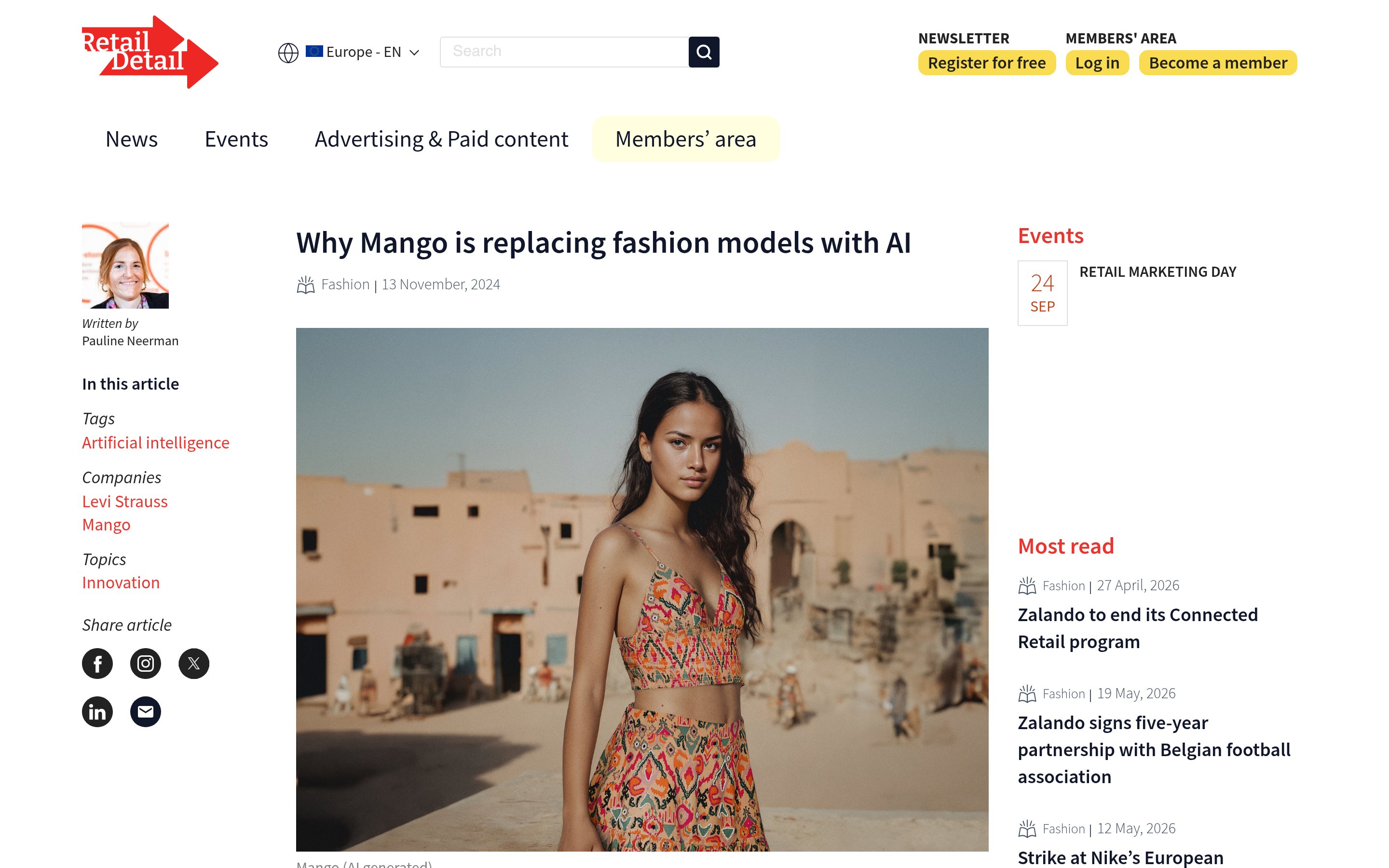
What's interesting is that the photos themselves didn't get more convincing between the two campaigns. The audience got used to the idea. The novelty wore off, and the work was clean enough that there was nothing left to complain about.
My read: Mango crossed the threshold where AI photography is just a tool, not a story. If your work is competent and you don't make a big deal of it, the discourse moves on within one campaign cycle. The first time hurts. The second time, almost nobody is keeping score.
Guess in Vogue: the uncanny valley, but not in the photo
In 2025, Guess ran a spread in Vogue featuring an AI-generated model in a pale blue romper and a chevron dress. The model looked photorealistic. The disclosure was a tiny line in the corner.
A TikTok creator called it out. The video did over 2 million views. The comments piled in: unrealistic beauty standards, taking work from real models, sneaky disclosure.
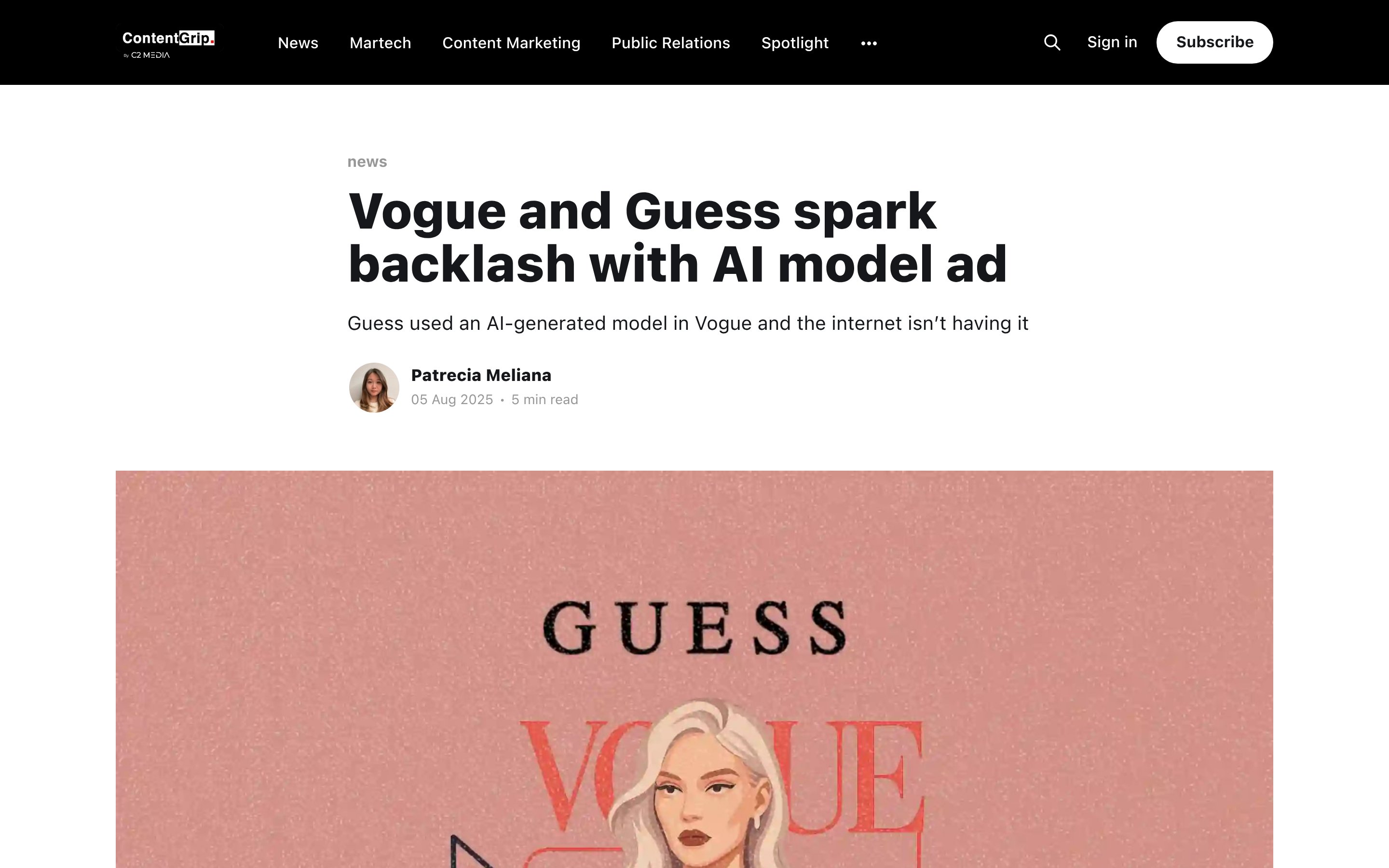
Here's the thing. The photo itself is clean. Nobody's pointing at the hands. Nobody's saying the lighting is wrong. The technical execution is fine.
What broke wasn't the AI. It was the venue and the disclosure. Vogue still carries a "this is curated, prestige work" expectation. The AI model felt like a shortcut on a stage where shortcuts read as disrespect. And the disclosure being three points of font in the corner felt like Guess was hoping nobody would notice.
If they'd put the same model in their own marketing channels with a normal-sized credit, this would have been a non-story.
My read: the photo wasn't the problem. The context was. Where you place an AI photo matters as much as how good the photo is.
H&M: when the AI is fine but the framing isn't
H&M took the most ambitious swing of the three. They scanned real, paid models to create digital twins, then started using those twins in marketing. The models still got paid. The AI itself was excellent.
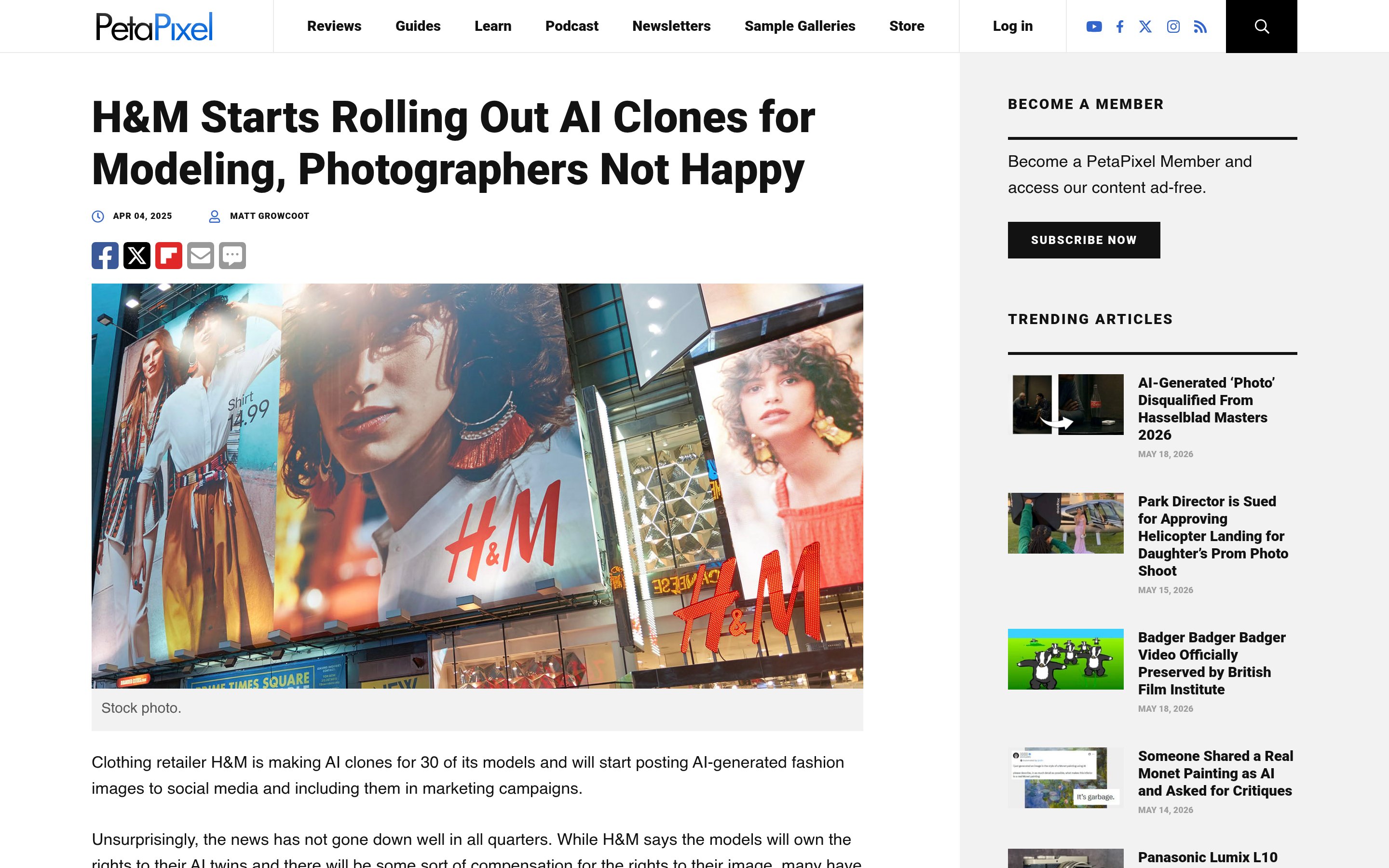
The backlash was the largest of any of these. The recurring phrase in the comments was some version of "nothing is authentic anymore."
What made it land harder than Mango or Guess: H&M wasn't replacing a generic AI model with another AI model. They were taking real human likeness and turning it into infinitely reusable content. That hit a different nerve. The complaint stopped being about whether the photo was fake. It became about whether the people in the photos still needed to be there at all.
My read: when the AI itself is competent, the backlash isn't about photo quality. It's about what the existence of the photo implies. H&M made the implication big and visible, and the public responded to the implication, not the pixels.
So do customers actually care?
This is where the answer gets interesting, because the survey data, the capability data, and the behavior data all say different things.
Stated concerns are high. A Clutch study found 95% of consumers have concerns about AI imagery, with 71% citing deception and 65% citing authenticity. Read straight, that says half the internet is about to boycott your store.
Capability tells a different story. In the same Clutch study, 66% of consumers said they were confident they could spot AI imagery before being tested. Once tested, only 43% actually could. Most people are wrong about their own detection ability, in the same direction. They think they can tell. They can't.
Behavior tells a third story. Mango's second campaign barely got criticized. ASOS quietly uses AI across thousands of listings. Calvin Klein, Moncler, and Balenciaga have all crossed over with minimal sustained pushback. The same Clutch data found 42% feel neutral about buying from sites that use AI product photos, 33% react positively, and only 25% react negatively. Most "concerned" shoppers still buy.
What's actually happening is the gap between what people say in a survey, what they think they can do, and what they do at checkout. The same shopper who tells a pollster they hate AI imagery will scroll a catalog, find a dress they like, and buy it without ever wondering how the photo was made.
The exception is when something else is already wrong. Which is the cleanest framing I've got for when AI photos actually cost you sales.
The three times AI photos backfire
These are the only situations I've seen where AI photos move the needle on revenue or trust, in either direction.
One: your brand trust is already shaky. Bad shipping, slow customer service, mixed reviews, a sketchy refund policy. When something else is broken, every detail becomes a thing to complain about, and AI photos are an easy thing to point at. Fix the underlying problem before you blame the photos.
Two: sensitive categories where the photo is the proof. Skincare where the customer is buying based on texture. Jewelry where the close-up is the whole pitch. Food. Anything where the photo isn't supporting evidence but the entire claim. In these categories, an AI photo that smooths the texture or sharpens the stone past reality isn't really an AI problem. It's overpromising, which would hurt you in a real photo too.
Three: the photo doesn't match the product. Wrong drape. Wrong color. Wrong scale. Buyer opens the box and gets something different from what they ordered. This shows up in return rates first, then reviews. It's the only AI photo problem that actually costs measurable money, and the fix is the same fix that applies to real photos: make sure the photo matches what arrives.
The first two are about trust context. The third is about accuracy. None of them are really about AI being AI.
What I'd do if I were launching today
Short version: I'd ship AI photos for most of the catalog without thinking twice. I'd keep one real photo per product as the hero shot, mostly as a sanity check on accuracy, not for disclosure reasons. I wouldn't call out that the rest are AI, and I also wouldn't pretend they aren't. If a customer asked, I'd answer.
I'd watch the return rate by category for the first month and compare it to the pre-AI baseline. If it ticked up, I'd look at which photos shipped before I blamed the model.
And I'd skip the "are we ready to use AI?" debate entirely. Most of my customers' customers crossed that bridge a year ago. They're not waiting for permission. They're already buying.
FAQ
Do I legally have to disclose AI product photos? In the US, not for most product photography. FTC guidance focuses on deceptive claims about the product, not how the photo was produced. Some marketplaces have channel-specific rules. The EU's AI Act adds disclosure requirements for synthetic media in certain contexts. Check your specific channel and jurisdiction before assuming.
Do AI product photos hurt return rates? Only when the photo doesn't match the product. A truthful AI photo and a truthful real photo perform the same on returns in the customer data I've looked at. The variable is accuracy, not production method.
What's Amazon's policy on AI product photos? Amazon allows AI imagery as long as the listing accurately represents the product. The main product image still has to match what arrives in the box. Lifestyle scenes are the most flexible category.
Will customers leave reviews calling out AI photos? Rarely on their own. When it does happen, the AI photo is usually mentioned alongside another complaint (shipping, sizing, quality). The AI is the symptom people point at when something else feels off.
Should I tell customers my photos are AI? Only if asked, and answer honestly. Volunteering a disclosure on every product page reads defensive and signals you think it's a problem. If you don't think it's a problem, don't act like one exists.
So, can they tell? And do they care?
Most can't. Most of the ones who can don't care. The ones who care almost always have a different reason to be upset, and the AI photo is just the closest thing to point at.
Ship the photos. Make sure they match what's in the box. Don't lie about it. Don't apologize for it.
Then go fix the thing they're actually upset about.