The best AI tools for UGC videos in 2026
AI UGC tools split into three jobs: avatar talking-heads for paid ads, product-URL-to-ad agents for variant testing, and faceless auto-publishers for organic TikTok. The right pick in each, plus the indie tools real operators are quietly using.
Which AI UGC tool to use for paid ad creative, which for organic TikTok, and which to skip entirely.
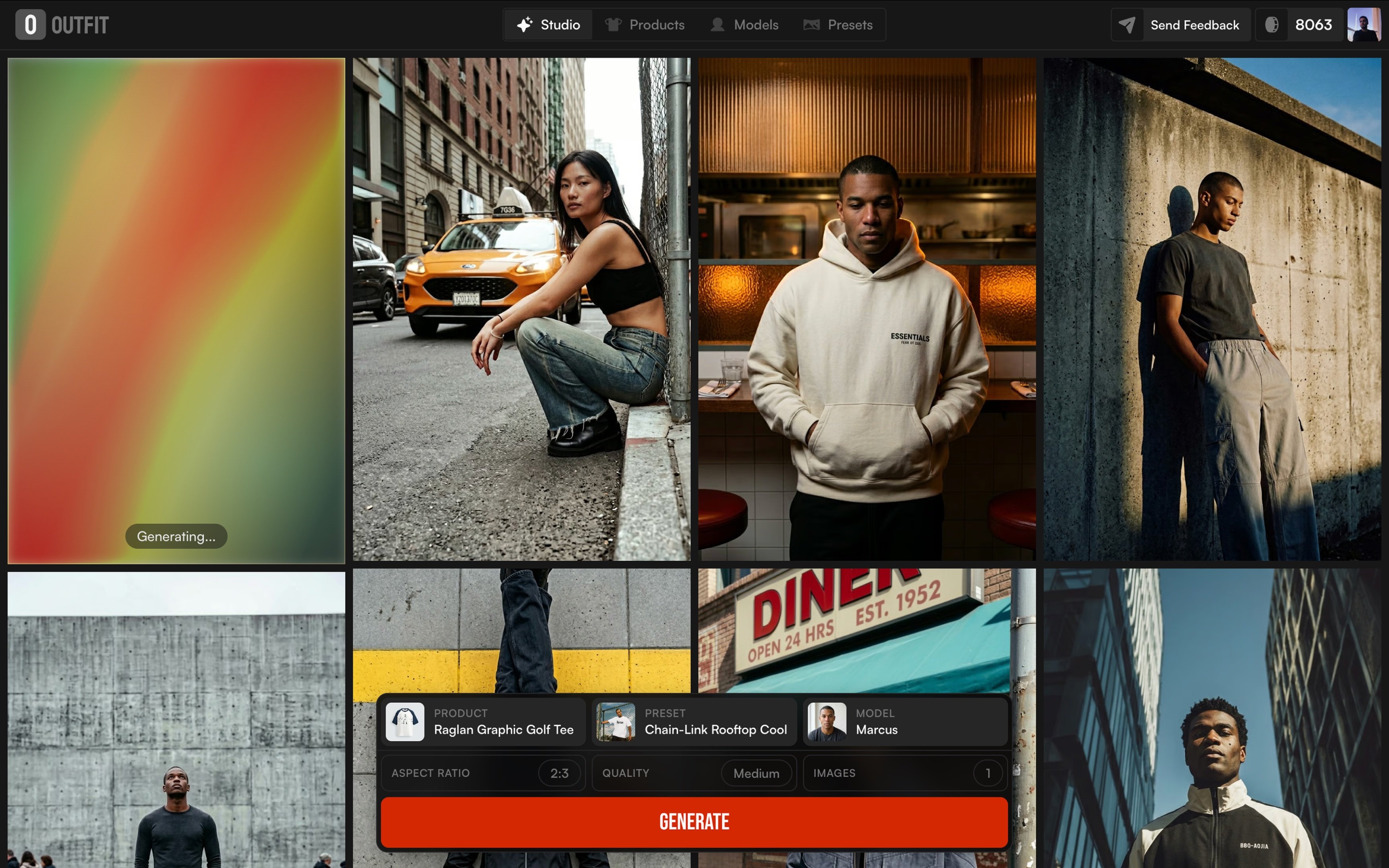
Quick answer. AI UGC is three different jobs in a trench coat. For Meta and TikTok ad creative with realistic avatars, use Arcads. For turning a product URL into a batch of ad variants overnight, use Topview. For auto-publishing faceless TikToks daily without you touching it, use Reel.farm. Most other tools are variations on one of those three.
AI UGC is three jobs, not one
The category got lumped together because everything in it generates video for social. But the work splits cleanly into three.
Arcads makes one AI actor talk to the camera about your product. Topview takes your product page URL and spits out 30 ad concepts. Reel.farm runs a TikTok account for you on autopilot. Those are three different jobs. Picking between them is less about which is "best" and more about which one matches what you're actually trying to do.
So before any picks, the category split.
The three categories of AI UGC video tools (and which one you actually need)
1. AI avatar talking-heads. A synthetic person looks at the camera and says your script. You write the script, pick an actor from a library, render. Output: a 15 to 30 second talking-head video that looks like a real creator review. Best for paid social ads where the format is "person talks about product."
2. Product-URL-to-ad agents. You paste a Shopify or product page URL, the tool scrapes the product photos and copy, then generates a batch of ad creatives. Some include avatars. Some are pure b-roll plus voiceover. Best for testing a lot of ad variants fast.
3. Faceless or auto-publishing organic tools. You set a niche and posting schedule. The tool generates videos (often slideshows or stitched stock) and posts them to TikTok for you, every day, without you reviewing each one. Best for filling an organic content calendar when you can't post manually.
You probably need one. Maybe two. Almost no brand needs all three at once.
If you're running paid Meta or TikTok ads → category 1 or 2. If you're trying to grow organic TikTok and don't have time to post → category 3. If you want both, you need two separate tools. Nothing does all three well.
Now the picks.
Category 1: AI avatar talking-heads (best for paid social ad creative)
This is the loudest part of the category. It's also the part that's getting commoditized fastest.
My pick: Arcads
Arcads has the best human realism in the category right now. Put an Arcads render next to a HeyGen render of the same script and the Arcads output looks like a real person; the HeyGen output looks like a polished avatar. That difference matters when you're paying Meta to put it in front of cold traffic. One published head-to-head from a DTC agency showed Arcads generating 2.3x the CTR HeyGen did on the same brand, same offer, same week.
1,000+ actors to pick from. Starter plan is $110/month for 10 videos. That's about $11 per render, which is steep until you compare it to what a human UGC creator costs ($150 to $400 per video, plus revisions).
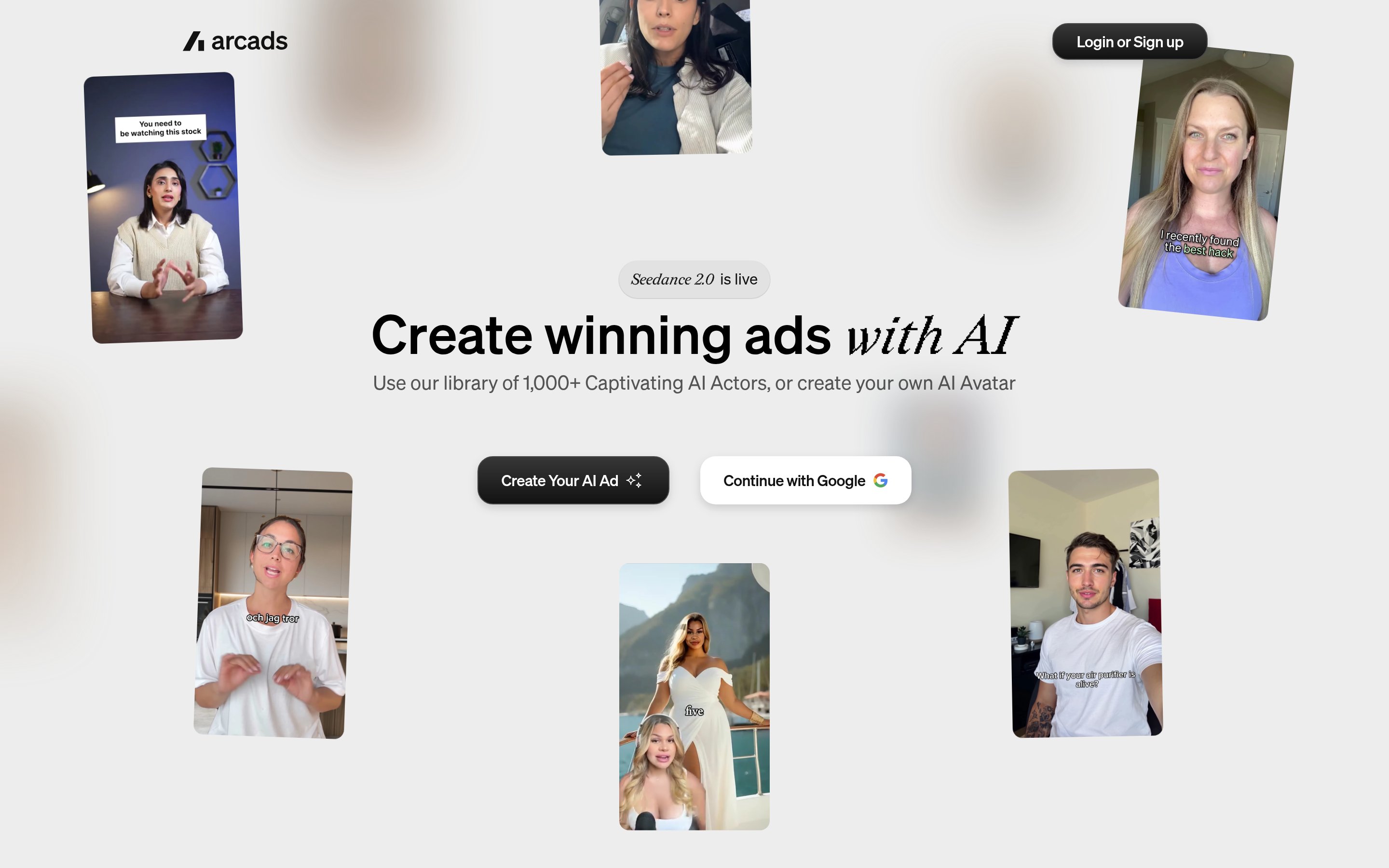
The catch: Arcads actors cannot hold or demo your physical product. They talk about it. They don't touch it. If your product needs to be seen in someone's hand, on someone's face, on someone's body, Arcads won't get you there.
Worth a look: MakeUGC
MakeUGC's pitch is the exact gap Arcads doesn't fill. Their avatars can be made to appear holding your product, generated from a single product photo. The realism isn't quite Arcads-level, but for a brand selling jewelry, cosmetics, or anything tactile, "the avatar is holding the actual product" beats "the avatar is talking about the product" almost every time.
$49/month Starter, but the product-in-hand feature you actually came for is locked to the $119/month Pro plan. Some Trustpilot billing complaints, so use the free trial first and check the cancellation flow before you put a card in.
Skip if
You sell anything where the product needs to be in motion or worn. Apparel, footwear, anything that drapes or moves. AI avatars wearing your clothes still look uncanny at the seams in mid-2026, and customers can tell. For those, real UGC creators still win. Use Arcads for the talking part, hire a human for the wearing part.
Category 2: Product-URL-to-ad agents (best for ad-variant testing at scale)
This is where the category is actually innovating. Avatar realism is a solved problem. The interesting work is in workflow: how fast can you go from product page to 30 testable ad variants in your Meta account?
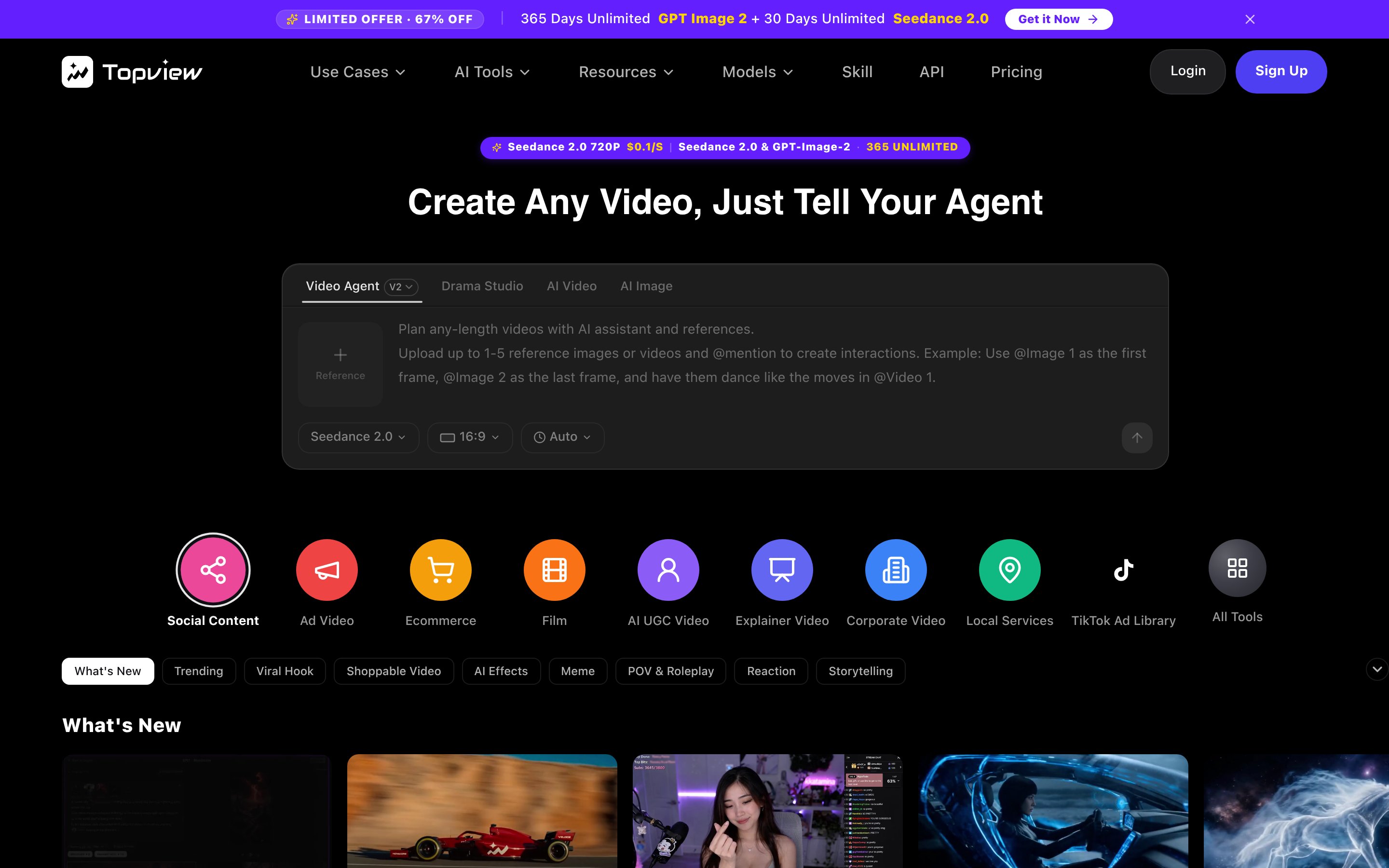
My pick: Topview
Topview's pitch is what hooked me. You paste your product URL, but you can also paste the URL of a TikTok ad you want to clone the concept of. It rebuilds that exact concept with your product. That "reference video" feature isn't standard in the category, and it shortcuts the part that usually takes the longest: figuring out what concept to test.
$16/month Pro plan on annual billing, which works out to roughly $0.35 to $0.57 per pro-quality video depending on how many credits you burn on regenerations. By far the cheapest cost per variant I've seen in the category.
The indie pick nobody's covering: PotionAds
PotionAds is the only tool in this category that's truly built for ecom product context. It rebuilds competitor ads using your brand colors, fonts, and product visuals, and ships 30+ variations from a single URL paste. Most URL-to-ad tools treat the product as a stock photo. PotionAds treats it as a brand asset.
It's barely on anyone's radar yet. Worth a free trial before you lock into a longer plan elsewhere.
Worth a look: Pippit (by ByteDance)
Pippit is from CapCut's parent company, which means two things: the underlying video engine is the same one millions of TikTok creators already use, and the publishing pipeline to TikTok Shop is first-class. If TikTok Shop is your primary channel, Pippit should be on your list ahead of Topview.
The downside is reliability. Reviews flag unstable uploads and occasional access losses. Bigger company, less polished product experience. Worth testing free before committing.
Skip if
You're testing one concept hard, not many concepts cheap. URL-to-ad tools optimize for variant volume. If your strategy is "make one great ad and pour budget into it," you don't need a batch tool. Hire a human UGC creator or use Arcads.
Category 3: Faceless / auto-publishing (best for organic TikTok growth without a person behind the camera)
This is the most misunderstood part of the category. These tools aren't making ad creative. They're filling content calendars.
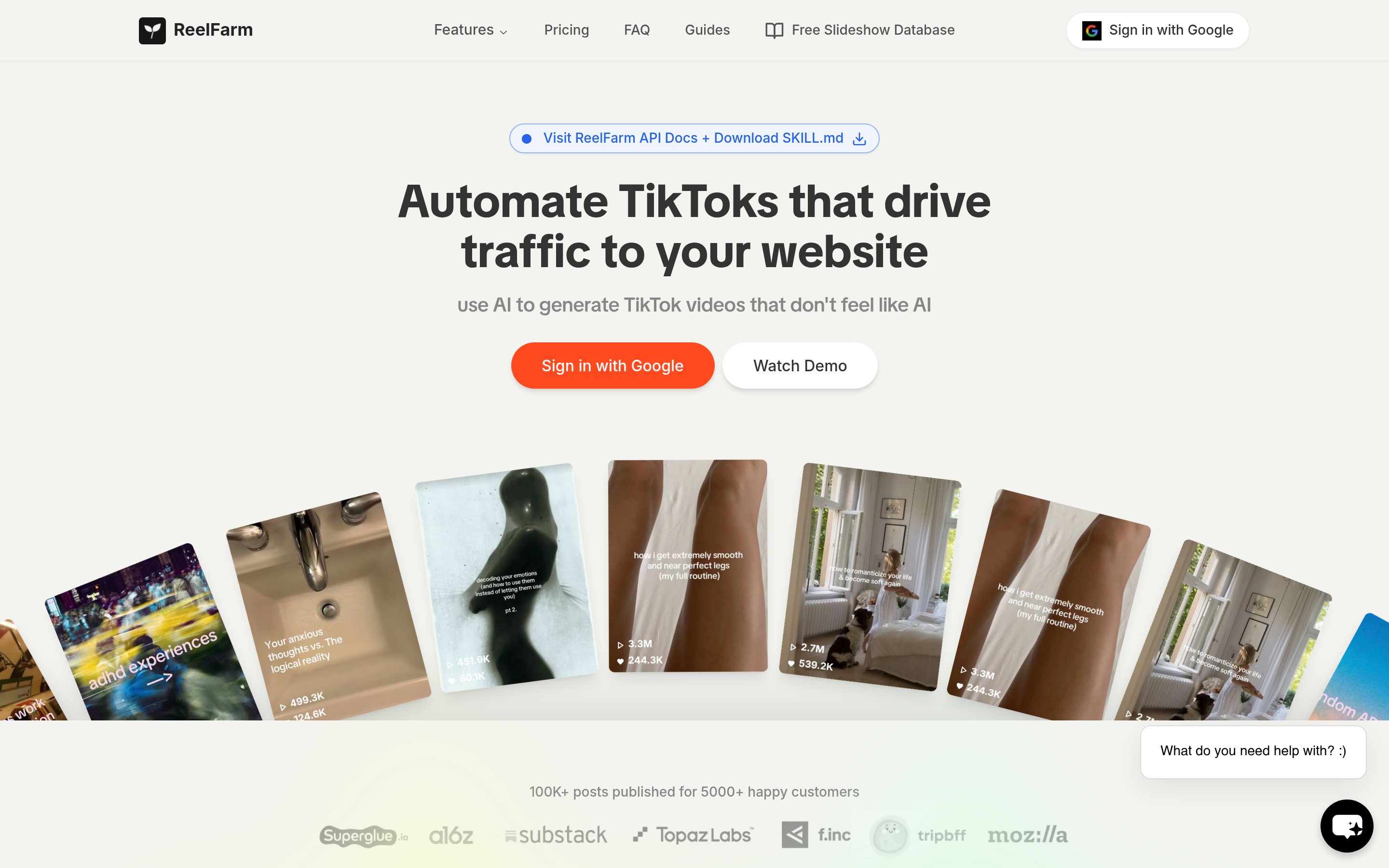
My pick: Reel.farm
Reel.farm is what people think the rest of the category is supposed to be: hands-off, autonomous, "wake up to content already posted." You give it a niche and a style. It generates videos daily (mostly slideshows with AI hooks, plus some avatar UGC) and posts them to TikTok for you. You don't write scripts. You don't approve clips. It just runs.
The founder, Matt Welter, hit $100K in revenue in 100 days as a solo developer, which tells you something about how badly ecom operators wanted this product. The indie crowd on Twitter has been quietly recommending it for months. Pricing starts at $19/month for 25 slideshows and tops out at $195/month for 750.
A reviewer who ran it for 90 days on a skincare brand summed it up well: the slideshow hooks were surprisingly decent. The AI avatars hit uncanny valley. The voiceovers lacked punch. His takeaway was that Reel.farm is a structure you fill with brand soul, not magic that replaces brand work. Treat it that way and it earns its place. Treat it as set-and-forget and you'll end up with a TikTok account that posts but doesn't convert.
Worth a look: SendShort
SendShort positions itself directly as "the #1 Reel.farm alternative" and its main edge is direct posting to TikTok and YouTube Shorts (Reel.farm is TikTok-only). If your strategy depends on YouTube Shorts traffic alongside your TikTok feed, SendShort is the right pick.
Skip if
You can post manually 3 to 4 times a week and actually want to. Auto-publishing tools save time at the cost of brand voice. If you're a small brand whose voice is your differentiator, posting yourself will outperform autopilot. The tool is for operators who already gave up on doing it manually.
The talking-head AI avatar format may already be peaking
Here's the part of the category nobody's quite ready to say out loud.
Matt Welter from Reel.farm posted publicly that his customers' AI slideshow content is outperforming the AI avatar UGC. A KANA post that went viral on X called the workflow "cyber farming" and described it as: drop your product, audience, and vibe at night, wake up to 50 ads, filter the 3 that worked. Nobody in that workflow is making one perfect talking-head video. They're making 50 mediocre slideshows.
The shift is real. AI talking-head UGC hit its realism ceiling sometime around late 2025. One more avatar tool getting one more degree of realism doesn't change much. The interesting work is moving to what comes after the avatar (the slideshow, the product-context shot, the auto-publishing layer).
If you're picking a tool today, weight category 2 and 3 higher than the hype around category 1 would suggest.
The disclosure question nobody wants to answer
Patrick Coddou, founder of Supply, posted recently that "fake UGC videos are basically illegal if not disclosed as AI." He's not wrong, even if "basically illegal" overstates the FTC's current enforcement posture.
The FTC's endorsement guidelines require disclosure when a "creator" in an ad isn't real, isn't actually a customer, and is being presented as one. An AI avatar reading a fake testimonial script without disclosure is the textbook risk case. Nobody's been fined yet at meaningful scale, but the rules are clear enough that you shouldn't bet your brand on the enforcement gap closing slowly.
What I'd actually do:
Use AI avatars for concept ads (the actor isn't claiming to be a customer, just showing the product).
Don't use AI avatars to fake testimonials or customer stories. Hire real customers for those, even if it's slower.
If you do use an AI actor in a way that could be read as a testimonial, add an "AI-generated" overlay. The CTR cost is small and you keep your brand on the safe side of the line.
This is the part of AI UGC that's going to age fastest. Set the disclosure habit now and you don't have to retrofit your whole ad library in 18 months.
What I'd actually use, by scenario
If you take nothing else from this post, take this part.
You're running Meta ads for a $30 product and want testable variants: Topview, $16/month. Run 30 variants this week. Kill the 27 that don't work. Scale the 3 that do.
You're growing organic TikTok and can't post daily: Reel.farm. Set it and check on it weekly to make sure the autopilot hasn't drifted from your brand.
You sell apparel, jewelry, or anything tactile and want the avatar to actually hold the product: MakeUGC over Arcads.
You want premium-feeling cinematic ad creative and have a budget: Higgsfield Marketing Studio. The output quality is closer to a real production than anything else in the category.
You're doing UGC content on TikTok Shop specifically: Pippit. The native publishing pipeline is worth the rough edges.
You're testing five concepts hard, not 50 concepts cheap: Skip this whole category. Hire one real UGC creator and spend the money on testing media.
Before you pick a tool: a quick checklist
Does the tool let you test free without a card? If not, walk away. The Trustpilot patterns on billing in this category are bad.
Does the avatar (if any) need to hold your product? If yes, Arcads is out. MakeUGC or hybrid creator-marketplace tools.
Are you generating for paid ads or organic feed? Different categories. Don't pick a category 3 tool for paid creative.
Are you OK posting AI content without disclosure? If not, factor that in before you scale.
What's your cost per variant after credit burn? Cheap plans get expensive when you regenerate.
Frequently asked questions
What's the difference between AI UGC and traditional UGC?
Traditional UGC is a real customer or creator making a video about your product. AI UGC is a synthetic creator (an AI avatar) or AI-assembled video designed to look like creator content. Performance is comparable for paid ad creative; trust and authenticity are higher for traditional UGC, especially in considered-purchase categories.
Is AI UGC allowed on Meta and TikTok?
Yes. Both platforms allow AI-generated ad creative, with disclosure required in some cases (especially political content on Meta). For product ads, AI UGC is generally allowed without disclosure on the platforms themselves, but FTC endorsement rules in the US may require disclosure if the AI is being presented as a real customer.
How much does AI UGC cost compared to hiring a real creator?
A real UGC creator costs roughly $150 to $400 per video, plus revision rounds and timeline. AI UGC tools range from about $0.35 per video (Topview) to $11 per video (Arcads), depending on the tool and your subscription tier. For testing dozens of variants, AI is 10x to 100x cheaper. For one hero ad you want to feel real, a human creator still wins.
Can customers tell when a UGC video is AI-generated?
In mid-2026, often yes, especially on close inspection. Avatars look real at first glance but break down on close-ups of hands, lip-sync, or product handling. For 6-second scrolling ads on Meta, most viewers don't notice. For 30-second product reviews on TikTok, regular viewers increasingly do. Test with your actual audience before assuming "they can't tell."
Which AI UGC tool is best for Shopify stores specifically?
Topview and PotionAds both integrate well with Shopify product URLs. Pippit is best if you're also selling on TikTok Shop. None of them require a Shopify app install. They all work off the public product page URL.
Conclusion
AI UGC is three different jobs. Find which one matches your actual problem, pick the tool inside it.
For most ecom operators in 2026 that's Topview for paid creative, Reel.farm for organic, and a human for the one ad you want to feel real.
Don't buy four tools. Pick one. Run it for 30 days. Then decide.